Saturday, January 1, 2011

Denominational Growth Development Scale


Dr. Win Arn
Father of American Church Growth


I have decided to dedicate this blog article to Dr. Winfield Arn. I first met Dr. Arn at a Pastors conference in Banff  Alberta while I was a young pastor. That meeting led to his coming to my hometown of Winnipeg to visit and help our church and the churches of our province. At his encouragement and using resources of films books seminars etc that he had written I was introduced into the role of helping churches in the wonderful task of making disciples. I set out in faith and founded the Canadian Institute for Church Growth as an extension of the Institute for American Church Growth, which he had founded.
Dr. Win Arn
In 1983 at his invitation I came to the United States and worked hand in hand with him for the next 20 plus years of my life. Together we travelled around the world training pastors and laity.
He can rightly be called the father of American Church Growth and the contribution he has made in resources of books, films, seminars, training kits and many other tools is unequaled to this day anywhere in the world.
I am proud to have had him as my boss, colleague, mentor and friend.
Dr. Arn has gone home to be with the Lord he loved and served and I know a welcome with “well done good and faithful servant awaited him.
He has left the legacy of his work in the hands of his son Charles Arn.

I know he would say that our best tribute to him would be to be busy about our Masters business of making disciples. I remember that virtually every time he heard of someone coming to the Lord as a result of helping a church, tears of joy would fill his eyes. He loved the Lord, loved his church and loved the world for which Christ died. Oh that we would carry on with that passion!


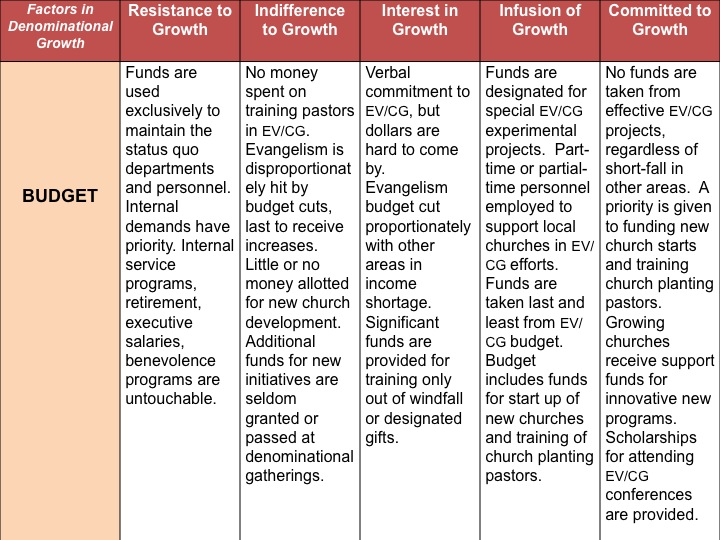
The Denominational Growth Development Scale


“Creating the Environment…So God Can Give the Increase”


Developed By: 

Drs. Win Arn, Charles Arn, Robert Orr


Dr. Bob Orr
We would like to share with you a unique attempt to identify and quantify the factors that influence a denomination’s or regional growth and/or decline. To our knowledge such an analysis has never been developed.  We hope this “Denominational Growth Development Scale” (DGDS) is a useful tool to help identify the critical ingredients in a denomination’s growth strategy, so that the efforts of its leaders may be focused on the influential issues of the church body’s health and growth.  This Scale grows out of the experience, observations, and research of the authors.


To read this Scale:
There are five stages in the DGDS, which are identified on the charts below. (“Resistance to Growth,” “Indifference to Growth,” Interest in Growth,” “Infusion of Growth,” and “Committed to Growth.”)  They are in sequence from “least conducive” to “most conducive” for denominational/regional church growth, evangelism and new church development. Denominational Growth Development


Dr. McGavran
With so many Denominations and Regional Judicatory struggling to find a way to reverse their decline, reach the next generation, plant churches or train leaders it is useful to look at what Dr. McGavran had observed. "If you want to see God's blessing look at what God's blessing and do that."
Drs Win and Charles Arn and myself evaluated our years of experience in observing, and consulting with over 70 denomination and with hundreds of Regional Judicatories and thousands of local churches and tried in this document to find a way to look at what effective denominations and regions did that set them apart from those that continued to struggle. This chart looks at one particular issue in the life and health of a denomination or region and weakness in this area does not mean weakness in every area. However a denomination or region that does not take seriously the task of helping it's churches accomplish their mission in seeking to reach persons with the gospel, and plant churches will find itself struggling as it seeks to have a fruitful future.

Another favorite McGavran “isim” is "We can be in the midst of a great harvest but we don't receive its blessings. We are like a farmer in a ripe field of wheat with a corn picker." 

With approximately 80-85% of churches either in plateau or in decline and according to a Southern Baptist Study almost 50% of churches not having a single conversion in the past 12 months. It would seem obvious that the leaders of these movements would want to look at everything they are doing and seek to learn all they could about how those regions or denominations that are effective in mission are doing it.


There are five stages in the DGDS, which are identified on the charts below. (“Resistance to Growth,” “Indifference to Growth,” Interest in Growth,” “Infusion of Growth,” and “Committed to Growth.”)  They are in sequence from “least conducive” to “most conducive” for denominational/regional church growth, evangelism and new church development. 
There is a description of 13 factors that influence a denomination’s culture and consequently its growth and future.  These factors are cross-referenced to the five stages of the DGDS and describe the scenario that is commonly found when a denomination is at each stage.
Throughout this post the term “EV/CG” is used as an abbreviation for “Evangelism/Church Growth.”  

Dr. Charles "Chip" Arn
A hard copy of this document including the Power Point can be emailed to you if needed.  We hope it stimulates productive discussion on how to move your churches forward in the pursuit of the call to “…go and make disciples.”  Please feel free to email me if I can be helpful in supporting your important leadership and ministry. My friend Dr. Charles Arn has spent most of his life helping regions and denominational bodies and either he or myself would be honored to help you if we can Feel free to email Dr. Charles Arn at chiparn@aol.com or me at bob@cscu.edu


The Charts

Purpose


Budget


Convictional & Theological Base


Seminaries & Bible Colleges


Resource Personnel


Power and Decision Making


Published Curriculum


Publications


Pastors: Attitude Towards EV/CG
Pastor:Placement


Pastor:Training


\


Denominational Growth Development Scale

“Creating the Environment…So God Can Give the Increase”

SELF-RATING CHART 

Place an “X” at the stage where you feel your denomination is at this moment, with regard to the 13 factors previously. The purpose of this exercise is to encourage discussion among denominational leadership concerning the present situation, and the future priorities for denominational growth and vitality.  If you are using this DGDS in a group, consider asking each person to complete the “Self-Rating Chart” independently, then compare answers and discuss.  May God bless your important leadership endeavors.

Concerning the “Factors in Denominational Growth,” I believe we are at the following stages:

PURPOSE
|                                    |                                    |                                    |                                    |  Resistance                 Indifference                       Interest                         Infusion of                   Committed            To Growth                   to Growth                       in Growth                           Growth                       to Growth
BUDGET


|                                    |                                    |                                    |                                    |  Resistance                 Indifference                       Interest                         Infusion of                   Committed            To Growth                   to Growth                       in Growth                           Growth                       to Growth 

CONVICTIONAL & THEOLOGICAL BASE


|                                    |                                    |                                    |                                    |  Resistance                 Indifference                       Interest                         Infusion of                   Committed            To Growth                   to Growth                       in Growth                           Growth                       to Growth

NEW CONGREGATIONS 
|                                    |                                    |                                    |                                    |  Resistance                 Indifference                       Interest                         Infusion of                   Committed            To Growth                   to Growth                       in Growth                           Growth                       to Growt
SEMINARIES & BIBLE SCHOOLS


|                                    |                                    |                                    |                                    |  Resistance                 Indifference                       Interest                         Infusion of                   Committed            To Growth                   to Growth                       in Growth                           Growth                       to Growt

RESOURCE PERSONNEL


|                                    |                                    |                                    |                                    |  Resistance                 Indifference                       Interest                         Infusion of                   Committed            To Growth                   to Growth                       in Growth                           Growth                       to Growth

POWER & DECISION-MAKING


|                                    |                                    |                                    |                                    |  Resistance                 Indifference                       Interest                         Infusion of                   Committed            To Growth                   to Growth                       in Growth                           Growth                       to Growth

PUBLISHED CURRICULUM
|                                    |                                    |                                    |                                    |  Resistance                 Indifference                       Interest                         Infusion of                   Committed            To Growth                   to Growth                       in Growth                           Growth                       to Growth


 PUBLICATIONS


|                                    |                                    |                                    |                                    |  Resistance                 Indifference                       Interest                         Infusion of                   Committed            To Growth                   to Growth                       in Growth                           Growth                       to Growth

PASTORS  (ATTITUDES TOWARD EV/CG)


|                                    |                                    |                                    |                                    |  Resistance                 Indifference                       Interest                         Infusion of                   Committed            To Growth                   to Growth                       in Growth                           Growth                       to Growth

PASTORS  (TRAINING)


|                                    |                                    |                                    |                                    |  Resistance                 Indifference                       Interest                         Infusion of                   Committed            To Growth                   to Growth                       in Growth                           Growth                       to Growth

PASTORS  (PLACEMENT)
|                                    |                                    |                                    |                                    |  Resistance                 Indifference                       Interest                         Infusion of                   Committed            To Growth                   to Growth                       in Growth                           Growth                       to Growth
LAY INVOLVEMENT


|                                    |                                    |                                    |                                    |  Resistance                 Indifference                       Interest                         Infusion of                  Committed            To Growth                   to Growth                       in Growth                         Growth                      to Growth

Tuesday, December 21, 2010

One Man Makes A Difference

One Man Makes A Difference

It was D. L. Moody who is credited with the observation that “The world has yet to see what God will do with a man or woman totally committed to the Lord”.

I know each of us can look back in our lives knowing we could have done more and that so often we got in the way of God doing all He could in us and through us.


This is the story of a man that God used in a miraculous way to change a Nation and set an example for generations to come..


Korea post Korean War was a country that was 97% Buddhist. It had endured Japanese occupation and a war that had left the country economically destitute, and morally and spiritually adrift. People from that era describe a situation where hopelessness was the most prevalent governing attitude of the majority. Today reasonable estimates show that South Korea is approximately 50% Christian. Ten (10) of the twelve (12) largest churches in the World are found there including the largest Assembly of God, the largest Presbyterian the largest Baptist and the largest Methodist churches in the world.

Dr. Kim Chi Sun
Into this situation God raised up a man called by his contemporaries the “Jeremiah of Korea”. Kim Chi Sun had returned to Korea after graduating with his Th D from Dallas Theological Seminary and began his ministry in the Presbyterian Church in Korea. His ministry however by God’s grace was larger than that. He helped the Korean churches revitalize and make a regular part of their lives the early morning-prayer times.

This practice when you experience it helps you to understand the phenomenal growth of the Korean church. Each day the salvation of their family, friends, work associates, and yes their whole nation is lifted with fervent passion before the throne of God.

Anyang University
founded by
Dr. Kim Chi Sun
To continue the story of Kim Chi Sun In 1948, Dr. Chi Sun Kim founded Tae Han Theological Seminary and College.  He was a pioneer in biblical education that enabled Korean men and women to study the Word of God and commissioned them to plant churches to spread God’s Word throughout the country and world.  Tae Han Seminary eventually became the liberal arts university known today as Anyang University, a city about one hour outside of Seoul, Korea.

It is also interesting to note that after the Korean War it was the disciples of Kim Chi Sun who ventured into North Korea to share the gospel with their communist countrymen. There has never been any denial of the oneness of the people of North and South Korea and the prayer for unification is prayed every day at the early-morning prayer services. These missionaries, 19 in all went to North Korea and 17 of them lost their lives for the sake of the gospel. This passion is still seen today by all who were touched by Kim Chi Sun’s life.

Dr. Billy Kim
A man with a warm heart and
a fiery message
Over the years, Dr. Chi Sun Kim served as a spiritual mentor to up and coming transformational Church leaders including Dr. David Yonggi Cho, the now retired Pastor of Yoido Full Gospel Church in Korea  (The world’s largest Church) and Dr. Billy Kim who served 45 years as pastor of the 15,000-member Central Baptist Church in Suwon, Korea before being elected to serve a five-year term as president of the Baptist World Alliance from 2000 to 2005.
Praying with Dr. Cho in his office

Dr. Cho tells the story of being taken as a young man to travel around the country to be with Dr. Kim and learn not only how to preach but how to minister with spiritual power and authority. Dr. Cho jokes that in the cold Korean winters they spent many nights sleeping under the same blanket.
 
Dr. Kim had prayed that God would give him a tithe of the nations souls for his labor and more that twice that number came to Christ through his ministry. The best estimates are that close to 6 million Koreans can trace their spiritual heritage to his ministry.

There have been numerous books written about Dr. Kim and the stories of how God used him would be an encouragement to any believer seeking to be used by God.

His passion for souls is reflected
 in the title and content of his
thesis "The Heart Of The Gospel"
I was particularly struck by a story told to me about Kim Chi Sun as I visited one of the churches he pastored in Seoul. During the Korean War Kim Chi Sun was targeted by the North Koreans for death because of the influence he had in the nation even before the war began. As the North Koreans came into the city they were approaching the church where Dr. Kim was praying with his family. Some Russian soldiers came and took them to safety literally minutes before they would have been slaughtered. He was sheltered and protected by these soldiers and when the war ended the Russian Embassy was hosted in his church. Many Russians were also won to the Lord through his ministry.

Dr. Samuel Kim
Founder and Chancellor
California State Christian University
He leaves not only a legacy that helped transform a nation but also a living legacy through his son Dr. Samuel Kim who felt God’s call to the many Korean immigrants to America and has planted churches in the United States and travelled around the world preaching the gospel. Continuing the legacy of training he formed California State Christian University that has expanded to not only train Korean leaders but English and Spanish leaders in the United States and through the cooperative work with indigenous nationals has taken the task of training leaders to more than 13 countries.

The purpose of this article as stated at the beginning is to ask the question,  "What would God be able to do with each of us if we let him?".

It is my prayer that God would use me and I trust it is your prayer that he would use you to do exceedingly more than we could ever ask or imagine.

Reaching Baby Busters(Gen X) With The Gospel


REACHING BABY BUSTERS WITH THE GOSPEL

America is feeling the effects of the baby buster or "X" generation The "X" was (popularized by author Douglas Coupland, who took it from Paul Fussell's 1983 book, Class), those born from 1964 or 1965 to 1980, though some sources give the cutoff date as 1975.
They're called "busters" due to a decline in the U.S. birth rate during this period. There were about 43-46 million people born in the U.S. during the "bust" years; adding immigrants and subtracting deaths, it's estimated that there are now 41 million still alive today.
These 41 million members are an important consumer-buying group, representing $125 billion in spending power.
They're 20% of the U.S. population and consist of the following ethnic makeup: 70% White, 13% Black, 12% Hispanic, 4% Asian, and 1% American Indian.
They are an important evangelistic focus for the church that hopes to have a bright tomorrow as the builder and boomer generations age and pass from the scene. It is also important to recognize that just as the Builders who were in excess of 60% churched themselves had the boomers who followed them be less than 45% churched. This ‘passing the faith’ issue has been exacerbated, as the Buster or Gen Xers are currently only 18% churched.
I had the privilege of meeting with a little over 100 Gen X students. With the generation following the Busters, the Millenniums’  (Born after 1982) only 10% or less are churched  at this time. We must  take seriously as Church leaders the responsibility of sharing the faith with our own generation and passing the faith along to the next generation. This task will put demands on the existing church like we have not seen in decades and how we meet the challenge may determine the future of the church in our country.

A REPORT TO THE STUDENT LEADERS
ON THE BABY BUSTER RESEARCH

INTRODUCTION


In order to assist the leaders of the South Carolina Baptist Churches in their ministry I was asked to conduct a series of focus groups which would interview groups of churched and unchurched Baby Busters. I visited 6 major university campuses on which Baptist Student Union ministers. There were 11 groups of people interviewed 6 of the groups were primarily churched and active in Baptist Student Union and 5 who were not active and primarily unchurched. This report is not prescriptive but descriptive of what we heard.

HOW DO BUSTERS VIEW THEMSELVES

Families

The majority of the unchurched (over 50%) came from divorced and broken families. Among the churched the percentage was nearer 40% but it was clear to us the broken family was a shaping force for this generation. The pain of this divorce and brokenness was seen in both the comments and the visible body language of the participants.

Entertainment

The busters as a group want life to be fun. This was a comment heard in reference to Baptist Student Union and why they attended as well as to why they did what they did with their free time.

Television

Sports, ER, Party Of  Five, Seinfeld, Cops, Days of Our Lives, and Cartoons were the most often mentioned. Three things emerged in the TV viewing patterns: 1. They like programs that portray real life, 2. They like programs that talk about real relationships, 3. They like programs that help them "zone out" and escape.

Music

While there is a broad spectrum of preference the musical preferences mentioned most often were classic rock and alternative music. Country music was liked intensely by about 50 % of the group but the other 50% seemed to hate it. The common denominators were that the music should be contemporary, have a beat, and be fun to listen to.

Fathers and Mothers

Mothers were praised and many students both male and female expressed how much help and how close they felt with their mothers. Fathers were described as distant or absent. It was clear that the absence of a father figure and example caused pain in these students. Students whose parents had remained married called themselves lucky.

Time

The baby busters live for today. The future is most often described as “scary”. There was a great deal of difficulty getting them to think much beyond the next few days.

Attention Span

The busters admit to having a short attention span. They state that if it doesn’t grab them they tune out quickly. They describe that which doesn’t have good flow and pace as boring.

Fixers

The busters feel they live in a broken world and the role of their generation will be to fix all the problems created by previous generations.

Marriage

Busters have rejected the easy divorce pattern of their parents. They describe marriage as “forever,” “takes work,” “permanent,” “a commitment to make it work.” The tend to talk about their grandparents rather than their parents as the good example.

Government

The most common descriptions were “corrupt”, “too big”, and “distant” “too intrusive”. They have a basic distrust of the political system.

Inner self

Busters have a desire to live with self-integrity.  They describe themselves as having a lot of internal pain. They are concerned that they do what is right in relationships, and that they are accepted by their peers. They struggle with knowing how to change to what they want to become.

Sex.

Scary and disease were the first words expressed. From the discussion with the unchurched it seemed clear that the fear of disease is doing more to drive persons to morality than abstinence for moral or spiritual reasons.

Welfare

There is not much support for welfare, as it presently exists. The busters describe it as “abused” “a mess,” “overburdened” “needing an overhaul”.


HOW DO BUSTERS VIEW THE CHURCH

In the context of the questioning I asked an open ended question, “When I say Southern Baptist (any other label could probably have been inserted) what’s the first things that come to mind. The perception of the church by the unchurched was the biggest surprise and shock to me as the researcher.


Racist

The unchurched and churched both condemned and described the church as racist. Christian kids having brought colored friends to church were told never to bring them back. Unchurched kids also described experience with churches that reflected an anti black pro white mentality. The busters describe themselves as tolerant and color blind. If this attitude is seen in churches it will virtually assure that this generation will be noticeable by its absence. It also knocks a huge hole in the traditional understanding of the homogenous unit principle. It was often assumed by church leaders that people wanted to worship “with our kind of people. The reality is, churches like this are the biggest turnoff to this generation as it reinforces the stereotype commonly held.

Legalistic

Baptist churches were describes as “intolerant”, “ Bible thumpers” and as “having more rules than God does”. People perceived this legalism and felt to become a member of a church would mean all fun in life would cease and they would be excepted to follow a long list of do’s and don’ts. Baptists were better known for what they are against rather than what they are for.

Boring

A good percentage of the unchurched had church experience. Both they and the church busters described church as boring, slow paced, and not relevant to their lives.

Political

There was a condemnation of what they described as “too political”. Even among the churched Busters they spoke with disdain about how the business of the church was conducted and how much conflict they observed with the pettiness and political infighting in what was done.

Traditional and not relevant

The church keeps on doing the same things and doesn’t change and adapt to where the world is.

Hypocritical

The non-churched knew Christians fall. Their condemnation is the hypocrisy of pretending you’ve got your act together when it is obvious you haven’t yet you condemn others for the behavior you exhibit.

Dress code

Both in these focus groups and previous groups people express that they don’t feel comfortable in Baptist churches because they either don’t like to dress up or can’t afford to dress up. This unwritten dress code was a frequently mentioned item.

God at a distance

The personal nature of God was seen as missing. They were looking for a God who is “right here” and felt that the church’s God was “out there”. Busters are looking for an immanent God who can be experienced and felt in the now. This might explain why Busters are attracted to cell or house churches.

A Sense of Family

The one item mentioned more often than any other and the only consistent positive remark about the church concerned the sense of acceptance and family that those who were regular participants felt.

HOW DO THEY VIEW EVANGELISM

I interviewed Baptist Student Union participants to discover what worked in evangelism. Methods that violate these finding are seen as ineffective.

Relational

A strong unconditional love for the prospect is prerequisite to any outreach. Having the bridge of friendship was seen as indispensable for any witness.

Patience

The BSU students acknowledged that it takes time, multiple exposures, and a willingness to hang in for the long haul.

Authentic

The life of the witness either validates or invalidates the message. We heard from the unchurched a clear rejection of the message based on the life of the witness.

Acceptance

The willingness to care for people with no conditions.

WHAT KIND OF CHURCH WILL REACH BUSTERS


We asked both churched and unchurched to describe the kind of church they would attend if given the chance. This list may be a valuable starting point for any church desiring to reach busters.

Contemporary

Music, use of audiovisuals were some examples of what they meant by contemporary.

Fast Paced

Services that are poorly planned and slow paced are described as boring.


Acceptance

The church that reaches the buster will be color and class blind.

Relevancy

Sermons and programs must help people make sense of the world they live in today. Religion to be relevant must be useful.

Small Groups.

The busters expressed the desire and importance of a non-threatening, caring, nurturing small group.

Growing.

Busters are attracted to churches that on the outside appear to be successful

Socially Active
Busters want to be part of a church that does mission and is serving people in practical ways. They want to feel the church is making a difference.

Community
They want a place to be accepted unconditionally.